How Small Vision-Language Models Fail at Pointing
July 1, 2026 · 11 min read
Introduction
A growing class of vision-language models can do something deceptively simple: look at an image, read a short instruction like “point to the mug on the left,” and return a coordinate. That capability, pointing, sits underneath a lot of practical systems: robot manipulation, assistive tools that act on what a user describes, UI agents, and any pipeline that has to turn “that one” into a location.
The usual way to evaluate a pointing model is a single number: how often its point lands on the right thing. That number is useful, and it is also incomplete. It tells you the rate of failure but nothing about the kind. For anything that acts on the output, the kind of failure is often what decides whether the model is usable at all.
pointfail is a small study and toolkit built around that gap. It evaluates four small, open vision-language models on three pointing benchmarks, and it sorts every miss into one of four failure modes, so the result is not just how often each model is right, but how it tends to be wrong.
This post walks through the idea, the methodology, and what the numbers say.
Why the kind of failure matters
Two models can share a hit rate and be nothing alike in practice. Picture two that each land on the target 40% of the time. One is a few pixels off on almost every miss; the other, when it misses, points at empty background. With a small tolerance the first is nearly a perfect model; the second is a coin flip that sometimes lands on nothing. The averaged score hides that completely.
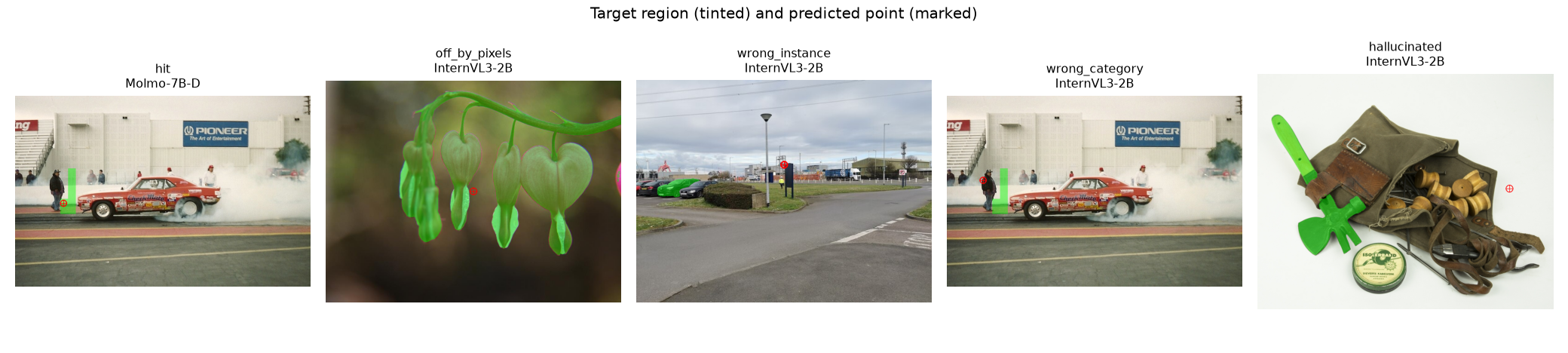
pointfail makes the distinction explicit with a four-bucket taxonomy:
| Bucket | Meaning |
|---|---|
off_by_pixels | Correct object, point just outside the target region. |
wrong_instance | Right category, wrong instance. |
wrong_category | Wrong object category. |
hallucinated | A point placed where no valid target exists. |
The buckets run from least to most severe, and the ordering reflects recoverability. A model whose misses cluster in off_by_pixels found the right thing and was slightly off; a small spatial tolerance recovers most of those. A model whose misses are mostly hallucinated is not locating the target at all. That difference is the whole point of the study.
Methodology
Task and outcomes
Each benchmark sample consists of an image, a natural-language instruction, and a binary ground-truth mask marking the acceptable target region. The mask is a region rather than a single coordinate for a simple reason: there is no one correct pixel for “the mug on the left,” and anywhere on the mug should count. That is also what keeps the marking objective, since a point is either inside the region or it is not.
The evaluated model produces free-form text from the image and instruction; a family-specific parser extracts zero or more points, normalized to the unit square. The first extracted point is taken as the primary prediction, and each sample resolves to exactly one outcome:
| Outcome | Condition |
|---|---|
hit | The primary point falls inside the ground-truth mask. |
miss | A point was parsed but falls outside the mask. |
no_prediction | No point could be parsed from the output. |
The hit test is a pixel lookup, so the primary metric involves no model judgment. The third outcome is kept separate on purpose: a model that answers wrongly and a model that fails to answer at all are different problems in deployment, and folding them together hides one of them.
The two-stage protocol
  flowchart LR
    I["image + instruction"] --> M["evaluated model points"]
    M --> C{"point in mask?"}
    C -->|yes| H["hit"]
    C -->|"no (parsed)"| MISS["miss"]
    C -->|"no point"| NP["no_prediction"]
    MISS --> J["Gemma 4 32B judge"]
    J --> B["off_by_pixels / wrong_instance / wrong_category / hallucinated"]
Stage 1 (geometric). Prompts are constructed per model family: benchmark-supplied answer-format directives are removed, and the core instruction is wrapped in the phrasing that elicits each family’s native output format (point tags for Molmo, a grounding template for InternVL3, an explicit pixel-coordinate request for Qwen2.5-VL). The intent is to measure pointing ability rather than sensitivity to one particular sentence format, so each model is asked in the phrasing it was trained on, as long as the answer stays checkable. Parsing then follows each family’s coordinate convention. These are actual outputs from the study, and they show why one shared parser would not work:
| Family | Raw output from the study | Convention |
|---|---|---|
| Molmo | <point x="42.0" y="68.6" alt="door handle.">door handle.</point> | 0 to 100 |
| InternVL3 | <ref>Point to the tool used for cutting wood.</ref><box>[[706, 370, 998, 607]]</box> | 0 to 1000, box center taken as the point |
| Qwen2.5-VL | (1802, 1234),(1976, 1520) | absolute pixels, first point primary |
Three dialects for the same answer: each is converted to a normalized coordinate before scoring, and scoring is the mask lookup defined above.
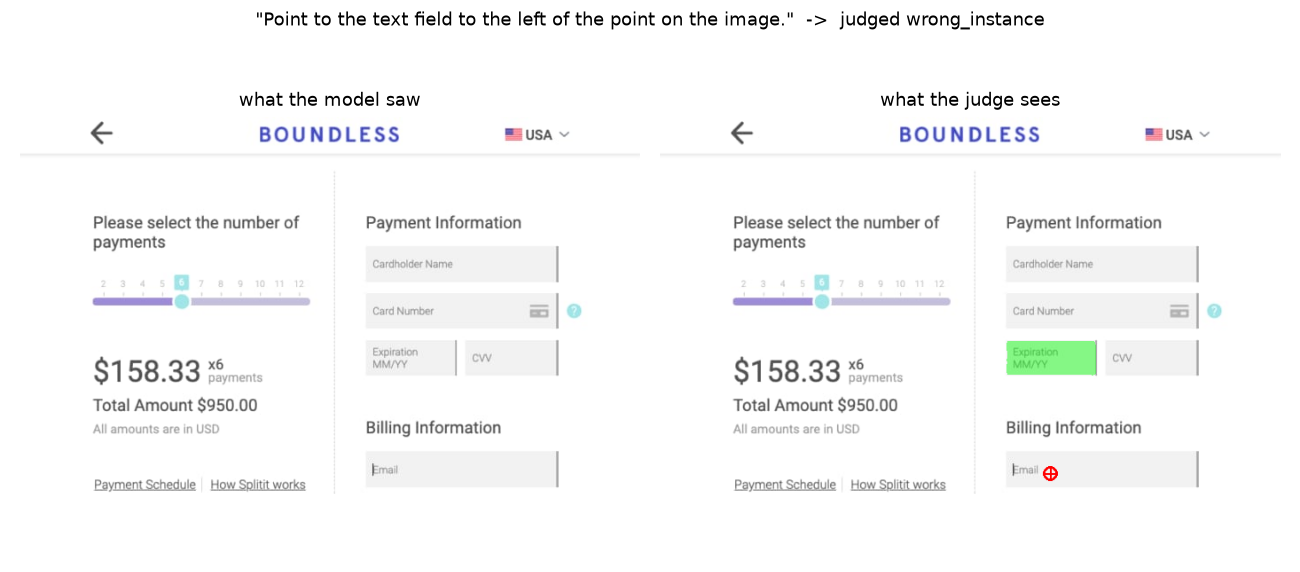
Stage 2 (semantic). Each miss is rendered as an annotated image: the ground-truth region tinted, the predicted point marked. The annotated image and the original instruction are presented to a judge model, which must select exactly one taxonomy label. The judge may abstain when no single label fits; abstentions are reported rather than forced into a bucket.
Below is one real miss from the study, shown both ways. The instruction asked for the text field to the left of the marker; the correct field is tinted green, and the model’s point (red) landed on a different text field. Right category, wrong instance:
The banner at the top of this post is the same rendering applied across the benchmarks: one hit and one example of each failure mode.
The judge
The judge is Gemma 4 in its 32B variant, accessed through Ollama. Two design constraints motivate the choice. First, the judge is out-of-family: none of the evaluated models is a Gemma derivative, so no model is graded by a system that shares its training lineage or output habits. Second, the judge sees only misses. Hits and unparseable outputs never reach it, so the headline hit rate is unaffected by any judge bias or error. If you distrust the judge entirely, the hit / miss / no-prediction numbers still stand on their own. Classification requests are independent per sample and are issued concurrently; the judge is never resident on the evaluation machine.
The protocol itself is deliberately narrow. For each miss, the judge receives the annotated image and a fixed prompt that restates the original instruction, explains that the green area is the correct target and the red marker is where the model pointed, gives a one-line definition of each of the four labels, and asks for exactly one label in reply. A response is accepted only if exactly one of the four label names can be read from it; anything ambiguous is rejected and the request is retried, up to five attempts. If no attempt yields a single clean label, the miss is recorded as unlabeled rather than being forced into a bucket. Every raw judge reply is stored in the released per-sample records, so any individual verdict can be audited after the fact.
One model at a time
The evaluated models require mutually incompatible dependency sets (the Molmo family and InternVL3 target one transformers release line; Qwen2.5-VL requires a newer one), so they cannot coexist in a single interpreter. Each model therefore runs in its own subprocess, which also solves the memory question in the most reliable way available: when a process exits, the operating system reclaims everything it held, with nothing left to clean up by hand.
  flowchart LR
    R["parent runner (no torch)"] -->|spawn per model| W["worker subprocess"]
    W --> L["load model in its interpreter"]
    L --> I["infer on samples"]
    I --> O["return predictions (JSON)"]
    O --> X["worker exits, memory freed"]
    X -->|next model| R
The parent process performs no model inference: it dispatches requests as JSON and collects predictions. Exactly one model is resident at any time, the operating system reclaims all model memory when each worker exits, and every model loads in exactly the environment that can run it.
Computing the metrics
All reported numbers derive from the per-sample records by plain counting. Formally, for a model \(m\) on a benchmark \(b\) with \(n_{m,b}\) samples:
Scoring a single prediction. The parsed primary point \(p = (p_x, p_y) \in [0,1]^2\) is tested against the binary ground-truth mask \(M\) of an image of width \(W\) and height \(H\):
$$ \mathrm{hit}(p) \;=\; \mathbb{1}\big[\, M(\lfloor p_y H \rfloor,\ \lfloor p_x W \rfloor) = 1 \,\big] $$A sample with no parseable point is a \(\mathrm{noPred}\), and everything else that is not a hit is a miss:
$$ \mathrm{miss}_{m,b} \;=\; n_{m,b} - \mathrm{hits}_{m,b} - \mathrm{noPred}_{m,b} $$Hit rate. The denominator is all samples, so a model gets no credit for declining to answer; a no_prediction counts against the hit rate exactly as a miss does:
Overall. The pooled rate sums raw counts across the three benchmarks (\(\sum_b n_{m,b} = 1359\) per model) rather than averaging the three percentages, so larger benchmarks carry proportionally more weight:
$$ \mathrm{overall}_{m} \;=\; \frac{\sum_b \mathrm{hits}_{m,b}}{\sum_b n_{m,b}} \;\;\neq\;\; \frac{1}{3}\sum_b \mathrm{hitRate}_{m,b} $$Failure composition. With \(c_{m,b}(k)\) the number of misses the judge cleanly labeled with mode \(k\) (one of off_by_pixels, wrong_instance, wrong_category, hallucinated), the share of each mode is computed over labeled misses only:
Judge abstentions, \(\mathrm{miss}_{m,b} - \sum_k c_{m,b}(k)\), are counted and reported separately, never redistributed into the modes, which is why bucket counts can sum to slightly less than the miss count.
Aggregation is deterministic: rerunning it over the same records reproduces the published tables byte for byte, and since the records themselves are in the repository, every number in this post can be recomputed independently.
Running it
The library is import-light: import pointfail pulls in no torch or transformers until you touch something that needs them.
from pointfail import scorePrediction

# parse a model's raw output in its own coordinate convention and test it
result = scorePrediction(
    family="molmo",
    rawText='<point x="50.0" y="50.0">mug</point>',
    imagePath="image.png",
    maskPath="mask.png",
)
print(result["primary"], result["inMask"])
The per-sample records ship in the repository, so the summary table and figures regenerate offline, with no GPU, from committed data, and a notebook does exactly that.
What the numbers say
Four models (Molmo-7B-D, MolmoE-1B, Qwen2.5-VL-3B, InternVL3-2B) across Point-Bench, Where2Place, and RefSpatial-Bench, for 5,436 individual pointing attempts. Point-in-mask hit rate (percent):
| Model | Point-Bench | Where2Place | RefSpatial-Bench |
|---|---|---|---|
| Molmo-7B-D | 68.3 | 24.0 | 46.9 |
| Qwen2.5-VL-3B | 38.6 | 25.0 | 25.6 |
| InternVL3-2B | 15.7 | 17.0 | 1.1 |
| MolmoE-1B | 14.3 | 10.0 | 2.5 |

The rate is only half the story. The failure profile is the other half. Hover any bar for exact counts, or click a legend entry to isolate a failure mode:

Reading the two together:
- Molmo-7B-D is the strongest by a wide margin and also fails the most gracefully: a large share of its misses are
off_by_pixels, the near-miss bucket. - Qwen2.5-VL-3B is second on hit rate, but on Point-Bench it returns no parseable point 221 times out of 982. Its usable accuracy is lower than the headline suggests, and it needs a fallback path for the answers it declines to give.
- InternVL3-2B and MolmoE-1B are weak everywhere, and their misses are dominated by
hallucinated: when they are wrong, they are usually pointing at nothing in particular. That is a more dangerous failure than being slightly off. - RefSpatial-Bench is the most discriminating of the three. It pulls the field apart (Molmo-7B-D at 46.9% against roughly 1 to 3% for the two weakest), which makes it the most useful benchmark for telling these models apart.
The practical reading: hit rate alone is a weak way to pick a model. If a small tolerance is acceptable, Molmo-7B-D’s near-misses are often recoverable; a model that mostly hallucinates gives you nothing to recover from.
What this isn’t
pointfail is intentionally not:
- A leaderboard of the best pointing models. It studies the small, open, locally-runnable segment on purpose; there is no large proprietary ceiling model in the pool.
- A training method. It measures and diagnoses; it doesn’t fine-tune anything.
- A general grounding benchmark. It is about pointing specifically (a single coordinate against a target mask), not boxes, captions, or VQA.
It is also small by design. The pipeline is a handful of readable modules: coordinate parsers per model family, a point-in-mask geometric pass, a judge, a subprocess runner, and an aggregator. It’s the kind of codebase you can read in a sitting and adapt to your own models or benchmarks.
Conclusion
For pointing models, how a model fails is often as important as how often. A single accuracy number flattens that away; a failure taxonomy brings it back. pointfail is a compact, reproducible way to measure both: geometry for the rate, an out-of-family judge for the kind. The result is a per-model profile you can actually make a deployment decision from.
The study in numbers:
| Metric | Value |
|---|---|
| Models evaluated | 4 |
| Benchmarks | 3 |
| Pointing attempts scored | 5,436 |
| Misses judged | 3,415 |
| Misses cleanly classified into the four modes | 3,151 |
| Overall hit-rate spread | 60.7% (best) to 11.6% (worst) |
The repository is on GitHub at codeadeel/pointfail under the MIT license, with the full per-sample results, generated tables and figures, documentation, runnable examples, and a reproducibility notebook. Issues, PRs, and feedback are welcome.
References
- pointfail on GitHub
- Molmo and PixMo (arXiv:2409.17146)
- Qwen2.5-VL Technical Report (arXiv:2502.13923)
- InternVL3 (arXiv:2504.10479)
- PointArena / Point-Bench (arXiv:2505.09990)
- RoboPoint / Where2Place (arXiv:2406.10721)
- RoboRefer / RefSpatial-Bench (arXiv:2506.04308)
- Ollama